ARTICLE
How to Choose a Home Health Agency
Start with Medicare certification, because without it Medicare will not pay. Then compare the agencies serving your area on Medicare’s own ratings. Then ask each one a short list of questions, because the answers tell you more than any star rating will.
Most families choose in a hurry. A discharge planner hands over a list, somebody picks a name, and the decision gets made in a hospital corridor. You are allowed to take longer than that, and you are allowed to change your mind afterwards.
This guide covers what certification means and how to read the public ratings. It also covers what the family survey measures, what accreditation adds, and the eight questions worth asking before you sign anything.

Start with Medicare certification
If your parent’s care is going to be paid for by Medicare, the agency has to be Medicare-certified. This is not a quality badge. It is a minimum requirement, and an agency without it means Medicare pays nothing.
Certification means the agency has been surveyed against federal standards and is subject to ongoing oversight. Plenty of good agencies are certified. So are plenty of mediocre ones. Treat it as the floor rather than the ceiling.
You can check certification, and compare agencies side by side, on Medicare’s Care Compare tool. Search by ZIP code and you will see every certified agency serving your area.
What the star ratings tell you, and what they miss
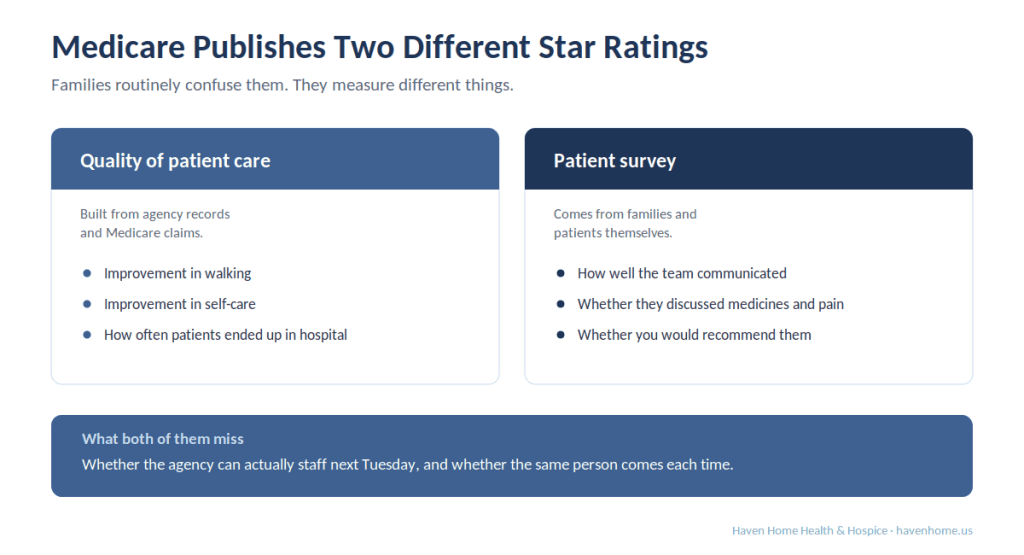
Medicare publishes two different star ratings for home health agencies, and families routinely confuse them.
The quality of patient care rating is built from clinical measures drawn from agency records and Medicare claims. It reflects things like whether patients got better at walking and at caring for themselves, and how often patients ended up in hospital during care.
The patient survey rating comes from families and patients themselves, through a national survey, and reflects their experience rather than clinical outcomes.
Two agencies can diverge sharply between these. An agency can post strong clinical numbers and still frustrate every family it serves, usually through poor communication. The reverse happens too.
What the ratings miss is just as important. They are slow, often reflecting care delivered a year or more ago. They say nothing about whether the agency can actually staff your parent’s visits next Tuesday. And they do not capture whether the same nurse comes each time, which is the thing families care about most once care begins.
Use the ratings to narrow a list. Do not use them to make the decision.
What the family survey measures
The patient survey asks the people who received care, and their families, about the things that are hard to measure clinically. How well the care team communicated. Whether they discussed medicines, pain and home safety. Whether the agency treated them with respect.
Two questions at the end are worth looking at. One is an overall rating out of ten. The other asks whether the person would recommend the agency to friends and family.
That recommendation question is the most useful number on the page. People who would not recommend an agency usually have a specific reason, and it is usually the same reason.
What accreditation actually adds
Accreditation is voluntary. An agency pays an independent organization to hold it to standards above the federal minimum, and submits to regular review.
Three bodies accredit home health and hospice agencies in the United States. They are The Joint Commission, the Community Health Accreditation Partner, usually called CHAP, and the Accreditation Commission for Health Care, or ACHC.
What accreditation tells you is that an agency chose to be inspected more often than the law requires. That is a reasonable signal. It is not a guarantee, and an unaccredited agency is not automatically worse.
Ask any agency you are considering whether they are accredited and by whom. The answer should be immediate. If it takes them a while to find out, that itself tells you something.
Eight questions worth asking
This is where you learn the most, and none of it appears on any rating page.
Will the same nurse come each visit? Continuity is the single biggest predictor of whether families are satisfied. Ask how many different people are likely to come in a month.
Who answers the phone at 9pm on a Sunday? Ask whether that person is local or at a national call center. Ask whether they can see your parent’s chart.
How quickly can someone get here? Ask for a realistic answer in minutes from their actual office, not a marketing promise.
How many patients does each nurse carry? Agencies know this number. An agency that will not share it is telling you something.
How do you communicate with my parent’s doctor? Ask what happens after each visit and how quickly the doctor hears about a change.
What happens if we are not happy with the person you send? The answer should be that they send someone else, without drama.
Are you accredited, and when was your last state survey? You can request survey results. An agency expecting that request is a good sign.
What is not included? Ask directly what they will not do, so you learn it now rather than in week three.
A good agency answers all eight without hesitating. An agency that deflects on staffing numbers or after-hours coverage is usually deflecting for a reason.
What else is worth weighing
Ownership and location. Ask who owns the agency and where the office is. A locally owned agency with an office nearby is not automatically better. It does mean the people making decisions live in the same community, and that the drive time is real rather than theoretical.
Whether they serve your actual town. Agencies list wide service areas and then struggle to staff the edges of them. Ask specifically about your address, not your county.
Whether they offer more than one service. Needs change. An agency that provides home health care, in-home care and hospice can adjust as they do. You avoid starting over with a new provider and a new set of faces.
Three things to take away. Medicare certification is the floor, not the ceiling. The star ratings narrow a list but they are slow and they miss staffing entirely. The eight questions above will tell you more in one phone call than an afternoon of reading ratings.
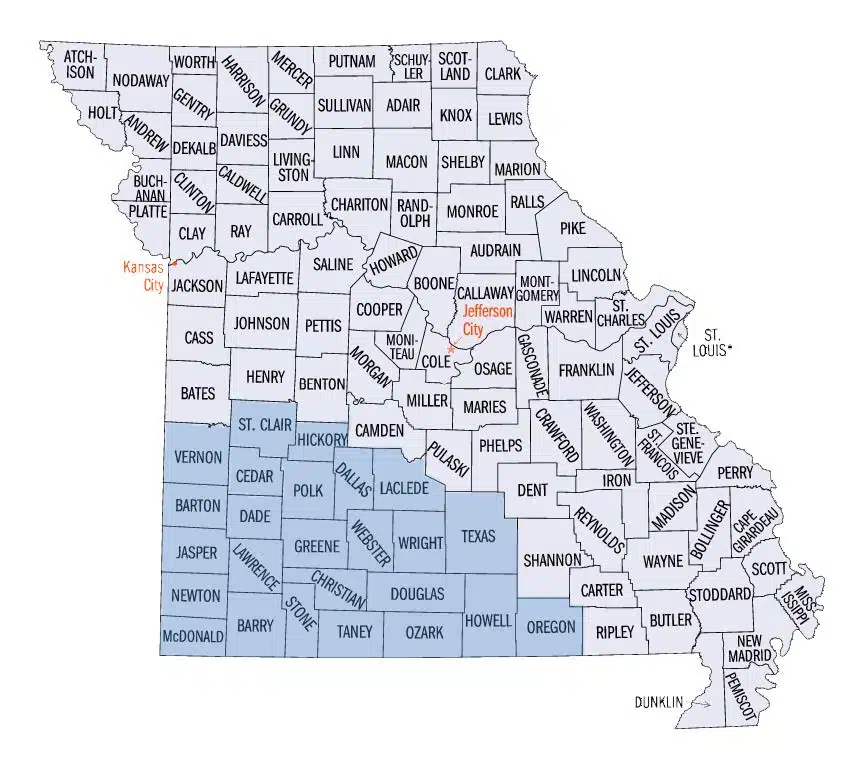
Haven is locally owned, with our office at 850 N 25th St, Suite A in Ozark, serving Springfield, Ozark, Nixa, Republic, Rogersville and Branson. Call and ask us all eight.
Take Action Now
Locally owned, with our office in Ozark
Haven provides home health, in-home care and hospice, so your family does not have to start over when needs change.