ARTICLE
Is Home Health Care Tax Deductible?
Often yes. The IRS treats payments for nursing services as a medical expense, and that covers far more than care given by an actual nurse. But two conditions decide whether it helps you: you have to itemize your deductions, and only the part of your medical costs above 7.5% of your income counts.
That second rule is why many families find the answer is technically yes and practically no.
This guide covers what the IRS counts, how to handle a caregiver who also does housework, the income threshold, whether you can deduct care you paid for a parent, and what does not qualify.
One thing before we start. This is general information, not tax advice. Haven is a home health and hospice provider, not a tax preparer. Take any of this to someone who prepares returns for a living before you act on it.

What does the IRS count as nursing services?
More than you would expect. This is the part most families get wrong.
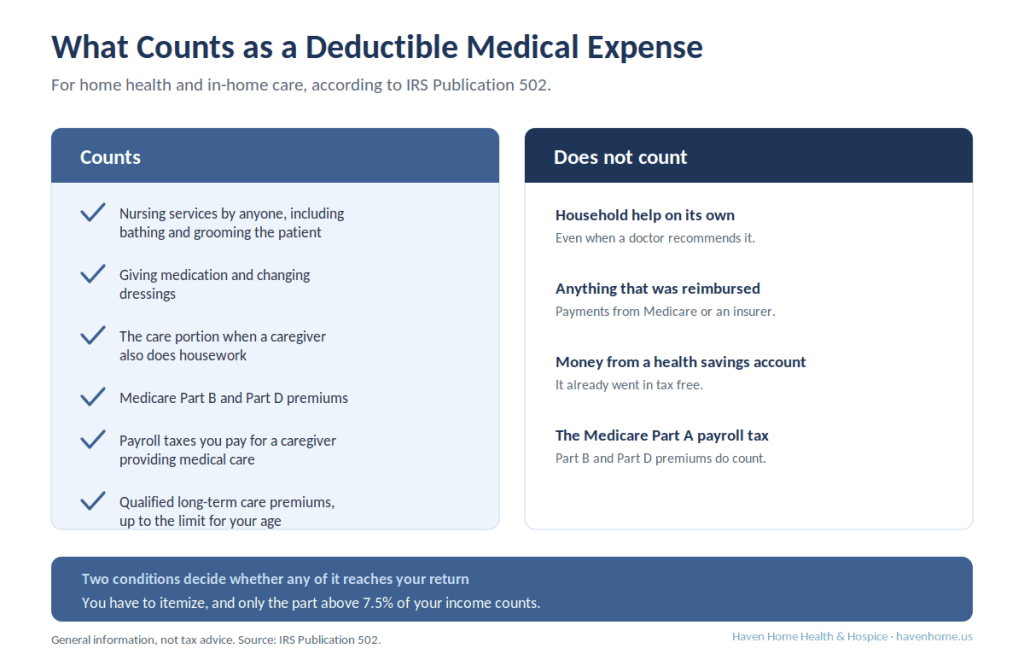
The IRS states that you can include in medical expenses wages and other amounts you pay for nursing services, and that the services need not be performed by a nurse as long as the services are of a kind generally performed by a nurse.
The publication goes further and names what it means: services connected with caring for the patient’s condition, such as giving medication or changing dressings, as well as bathing and grooming the patient.
Read that again, because it matters. Bathing and grooming count. So an aide who is not a nurse, helping your mother bathe and take her medication, is providing a deductible service. The job title does not decide it. The task does.
The IRS also confirms those services can be provided in your home or another care facility.
What if the caregiver also does housework?
Then you split the cost, and only the care portion counts.
The IRS is direct about this. If the attendant also provides personal and household services, the amount you paid has to be divided between time spent on household work and time spent on nursing services.
Their own example is worth borrowing. A family pays a visiting nurse $300 a week for medical and household services. Ten percent of that time goes to household tasks such as washing dishes and laundry. The family can include $270 a week as a medical expense. The $30 allocated to housework cannot be included.
Practical consequence: keep records. If your caregiver’s time is split, ask for timesheets that separate the two, or agree a reasonable percentage in writing and stick to it. Reconstructing it next April from memory is how deductions get lost.
There are two useful extras here. You can include part of what you pay for that attendant’s meals, divided the same way. And if you had to pay more for household upkeep because of the attendant, such as extra rent for a larger apartment, that extra amount can be included too.
How much can you actually deduct?
Only the part above 7.5% of your adjusted gross income, and only if you itemize.
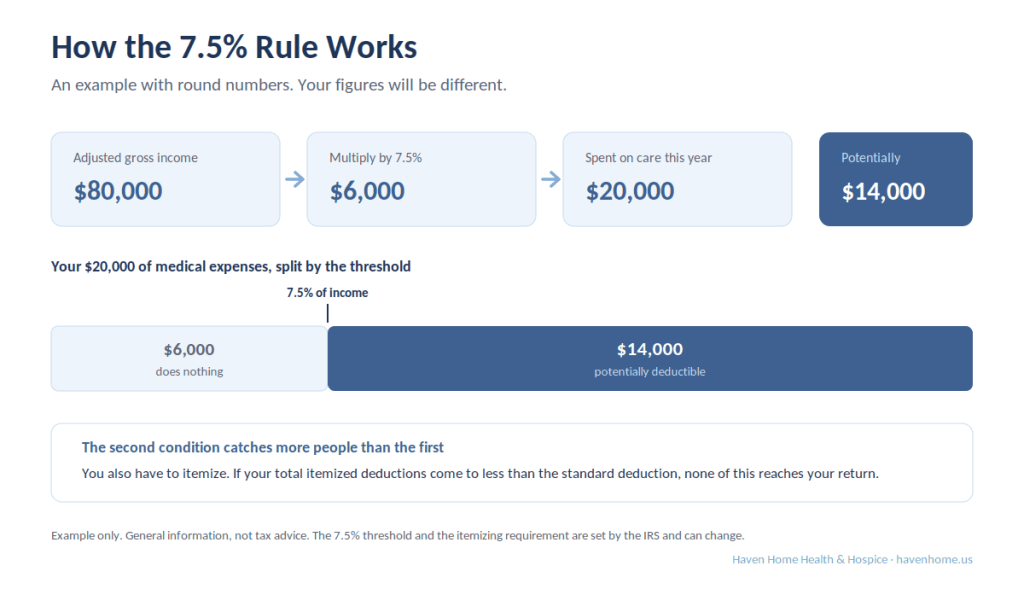
The IRS rule is that you can deduct on Schedule A only the part of your medical and dental expenses that is more than 7.5% of your adjusted gross income.
What that means in practice. If your adjusted gross income is $80,000, the first $6,000 of medical expenses does nothing for you. Spend $20,000 on care and $14,000 is potentially deductible.
The second condition catches more people than the first. You have to itemize rather than take the standard deduction, and the standard deduction is large enough that many households are better off taking it. If your total itemized deductions come to less than the standard deduction, the medical expense deduction gives you nothing at all.
This is the single most common reason families discover the answer is yes in theory and no on their actual return.
Can you deduct care you paid for a parent?
Sometimes, and the rule is more generous than most people assume.
You can generally include medical expenses you paid for someone who was your dependent when the care was provided or when you paid for it. But the IRS also allows you to include expenses for a person who would have been your dependent except that they had too much income. For 2025, that income figure is $5,200.
That exception matters for adult children. A parent drawing Social Security and a small pension will usually exceed the dependent income limit, but you may still be able to include the medical costs you paid on their behalf, provided you covered more than half of their support.
If several siblings share the cost, look up multiple support agreements. The IRS has a specific rule for that situation, and it changes who can claim what.

Articles
What Hospice Costs
Learn about what hospice actually cost and how you can plan for this event.
What about hospice, insurance premiums and payroll taxes?
Hospice. Care in a facility, including meals and lodging, counts as a medical expense where a principal reason for being there is to receive medical care. Hospice services themselves are medical care. In practice, most Medicare hospice costs are covered in full anyway, so there is little left to deduct. We cover that in our guide to what hospice costs.
Medicare premiums. Premiums paid for Medicare Part B and Part D are medical expenses. The payroll tax paid for Part A is not.
Payroll taxes on a caregiver. If you employ a caregiver directly, you can include as a medical expense the Social Security tax, Medicare tax, federal unemployment tax and state employment taxes you pay for an attendant who provides medical care. If that attendant also does household work, only the share tied to medical services counts.
Employing someone directly brings its own obligations around withholding and reporting. That is another reason to involve a tax preparer rather than working it out alone.
Long-term care insurance. Premiums for a qualified long-term care policy are deductible up to a limit that rises with age. For 2025 the caps run from $480 for someone aged 40 or under to $6,020 for someone aged 71 or over, per person.
What does not qualify
Three things catch families out.
Household help on its own. The IRS is explicit that you cannot include the cost of household help, even when a doctor recommends it. A housekeeper is a personal expense. The nursing services rule above is the exception, not a loophole around this.
Anything an insurer reimbursed. You reduce your total medical expenses by every reimbursement you received, including payments from Medicare. You cannot deduct what you did not actually pay.
Expenses paid from a health savings account. Money that already went in tax-free cannot be deducted again on the way out.
Talk to someone who does this for a living
Three things to take away. The IRS counts far more as nursing care than most families realize, including bathing and grooming by someone who is not a nurse. You have to split the bill if your caregiver also does housework, so keep records now rather than next April. And the 7.5% threshold plus the need to itemize is what decides whether any of it reaches your return.
This article is general information and not tax advice. Tax rules change, and your situation is specific to you. Take this to a tax preparer, and take your care invoices with you.
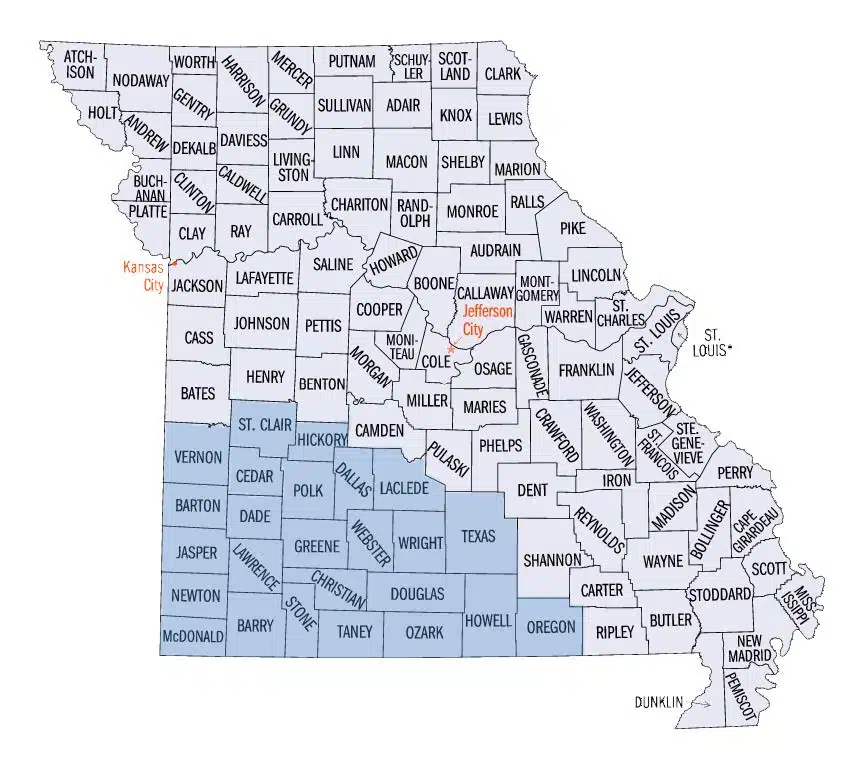
Haven is locally owned, based in Ozark, and serving Springfield, Ozark, Nixa, Republic, Rogersville and Branson. Call to ask what our services cost and what documentation we can provide for your records.
Take Action Now
Need invoices for your records?
Call to ask what documentation we can give you for your tax preparer.