ARTICLE
What Hospice Doesn’t Always Tell You
Most hospices do tell you these things, technically. They’re in a packet you sign during one of the hardest weeks of your life, at a moment when nobody is really reading closely.
So let’s say them out loud instead. These are the six things families most often tell us they wish someone had explained before they signed anything: how often a nurse actually shows up, what Medicare won’t pay for, what you might still owe, whether you can change your mind, why ownership matters, and how to check out a hospice before choosing one.
None of this is a reason to avoid hospice. It’s simply a reason to walk in with your eyes open. If you’re weighing this decision right now, you can call our hospice team in Ozark and ask any of these questions before committing to anything.
Call our hospice team in Ozark
Talk with a Haven about whether your parent qualifies, what Medicare pays for, and what the first week looks like.

Does hospice provide 24-hour care at home?
No, and this is the biggest gap between what families expect and what they actually get.
Hospice at home means visiting care, not round-the-clock care. In 2024, patients receiving the standard level of hospice care got an average of 3.9 in-person visits per week, each lasting just under an hour, according to the Medicare Payment Advisory Commission. That works out to roughly 3.6 hours of staff time across an entire week.
The rest of the week falls to you. Bathing, medication reminders, helping her to the bathroom at 3 a.m., sitting with her when she’s frightened. Your hospice team trains you for it, supports you through it, and answers the phone any hour of the day or night. But they aren’t in the house doing it for you.
That phone line matters, though, and it’s worth understanding exactly what it offers. A nurse is available by phone day and night and can come out for a crisis. That’s different from a nurse simply being there.
What are the four levels of hospice care?
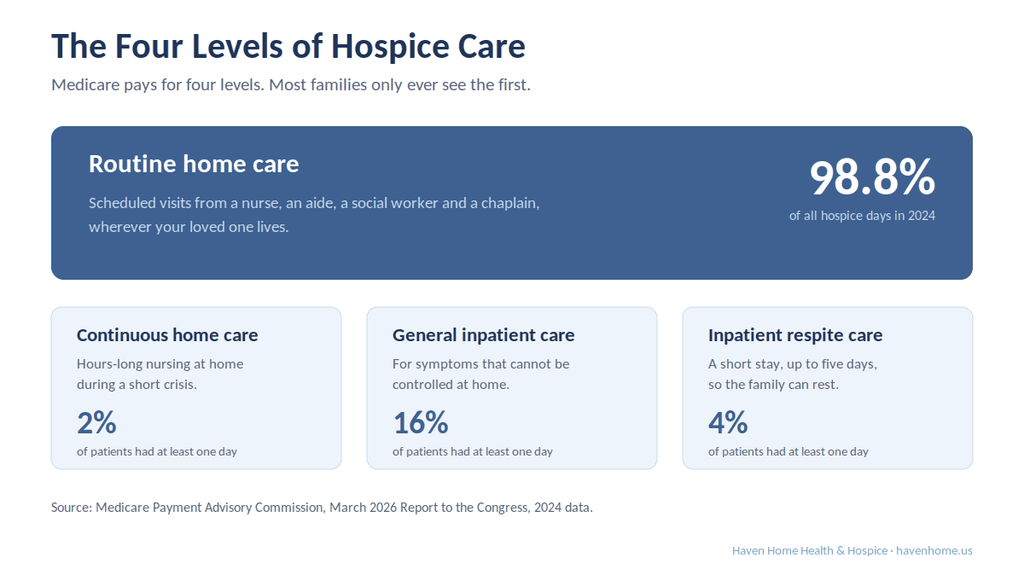
Medicare pays for four levels, but most families only ever see the first one.
Routine home care. This is the standard level: scheduled visits from a nurse, an aide, a social worker, and a chaplain, wherever your loved one lives. It made up 98.8% of all Medicare hospice days in 2024.
Continuous home care. Short-term, hours-long nursing care in the home during a crisis, meant to manage symptoms and avoid a hospital trip. Only 2% of patients received even a single day of it in 2024.
General inpatient care. For symptoms that can’t be controlled at home, delivered in a hospital or hospice unit. 16% of patients had at least one day of this.
Inpatient respite care. A short stay, up to five days, so the family caregiver can rest. 4% of patients had at least one day.
The point here isn’t that the higher levels are being withheld from anyone. They’re for specific situations, and most people genuinely don’t need them. The real point is that if you’re picturing hospice as a nurse at the bedside every single day, that picture isn’t accurate, and it’s far better to know that in week one than to discover it in week three.
If daily hands-on help is what your family actually needs, that’s a separate service that can run alongside hospice.
What doesn’t Medicare hospice cover?
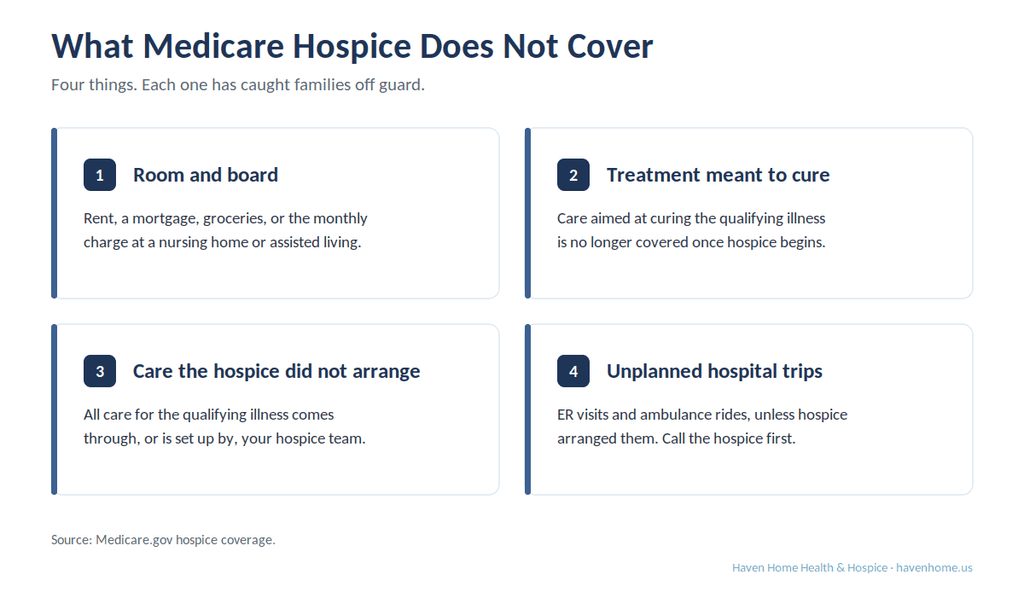
Four things. Medicare’s own hospice coverage page lists them, and each one has caught families off guard at some point.
Room and board. Medicare doesn’t pay rent, a mortgage, groceries, or the monthly charge at a nursing home or assisted living facility. The hospice care itself is covered. The roof over it is not. For a family whose mother lives in assisted living, this is the detail that matters most, and we walk through exactly how it works in our guide on what hospice costs.
Treatment meant to cure the illness. Choosing hospice means shifting the goal of care from cure to comfort. Treatment aimed at curing the qualifying illness is no longer covered. Medicare still pays for care related to health problems unrelated to that illness, though the usual deductibles and coinsurance still apply there.
Care the hospice didn’t arrange. All care for the qualifying illness has to come through your hospice team, or be set up by them. You can keep your regular doctor by naming them as your attending medical professional, but you can’t quietly bring in a second hospice or an outside provider for that same condition.
Unplanned hospital and ambulance trips. Emergency room visits, hospital stays, and ambulance rides aren’t covered unless your hospice team arranged them, or unless they’re for something unrelated to the qualifying illness. This is the one that leads to surprise bills.
Call the hospice first, even at 2 a.m. That’s exactly what the on-call line is for.
Will you pay anything out of pocket?
Almost nothing, and there’s no deductible at all.
Medicare’s official hospice benefits booklet lays out two possible charges. You may owe a copayment of up to $5 per prescription for outpatient drugs used for pain and symptom control. And if your loved one has a short inpatient respite stay, you may owe 5% of the Medicare-approved amount, which can never exceed the inpatient hospital deductible.
That’s the entire list. If a hospice ever asks you for anything beyond those two items for covered care, it’s completely fair to ask them to show you exactly where that charge comes from.
Need more than visiting care?
In-home care covers the rest of the week
Bathing, dressing and personal care
Meals, errands and light housekeeping
Companionship, by the hour or overnight
Can you leave hospice, or switch to a different one?
Yes to both, and this tends to surprise families the most.
You can change hospices once during each benefit period. Federal rules state that a person or their representative may change their designated hospice once in each election period, and that doing so doesn’t count as a revocation. If the team isn’t a good fit, you aren’t stuck with them.
You can also stop hospice altogether, at any time. This is called revoking. The rules allow you to revoke your election of hospice care at any point during an election period. Your regular Medicare coverage picks back up right away, and you can choose hospice again later if you still qualify.
People revoke for perfectly good reasons. A new treatment becomes available. A family decides they want to try the hospital one more time. Choosing hospice isn’t a door that locks behind you.
Why does it matter who owns the hospice?
Because the hospice landscape has shifted a great deal in recent years, and most families have no idea.
In 2024, about 82% of hospices were for-profit, and they served 60% of Medicare hospice patients. The number of nonprofit and government-owned hospices has been shrinking for years, while for-profit providers, many owned by national chains and investment firms, have grown.
Ownership alone isn’t a verdict on any one hospice. There are excellent for-profit hospices and plenty of mediocre nonprofit ones. But the research is still worth knowing. Two studies cited by the Medicare Payment Advisory Commission found that nonprofit hospices scored better on the national family experience survey than for-profit hospices owned by chains or private equity firms.
One more number worth keeping in mind: in 2024, 19.1% of hospice discharges were live discharges, meaning the patient left hospice without having died. Some of that is completely healthy. People improve, or change their minds. But a hospice with an unusually high rate compared to others can be a sign of a provider admitting people who were never truly eligible in the first place. It’s a fair question to ask before you choose.
Haven is locally owned, with our office at 850 N 25th St, Suite A in Ozark, and we serve Springfield, Ozark, Nixa, Republic, Rogersville, and Branson. The nurse who comes to your door lives right here in the Ozarks. That isn’t a claim about quality on its own, but it is a fact you can check, which is more than can be said for most marketing.
How do you check out a hospice before choosing one?
You have more information available than most families realize, and every bit of it is free.
Medicare Care Compare. You can search hospices by ZIP code and compare them side by side at medicare.gov.
The family experience survey. Every hospice reports scores from a survey of family caregivers, taken after the death. Two numbers are worth paying attention to: the share of families who rated the hospice a 9 or 10, and the share who said they’d definitely recommend it. Nationally, in the most recent period, the middle-performing hospice scored 82% and 85% on those two measures.
End-of-life visits. This measure shows how often a nurse or social worker actually visited in person on at least two of the last three days of life. The middle-performing hospice managed 61%, though performance varied widely from one provider to the next.
Ask directly. How many patients does each nurse carry? Who answers the phone overnight, and are they local to the Ozarks or sitting in a call center somewhere else? How quickly can someone actually get here from Ozark? What happens if you need them on Christmas Day?
A hospice that answers questions like these without hesitating is telling you something worth paying attention to.
Asking isn’t the same as committing
Three things worth holding onto. Hospice at home means visiting care, so it’s worth planning ahead for who covers the rest of the week. Medicare pays for nearly everything except room and board, and those exceptions are worth reading closely before you sign anything. And you can change hospices, or stop entirely, at any time, without any penalty.
You’re allowed to ask all of this before you enroll in anything. A good hospice will answer plainly and won’t rush you.
Haven is locally owned and based in Ozark. Call us at 417-731-7055 to ask what hospice would cover for your family and what the first week would actually look like.
Take Action Now
Call to ask whether it is time
Locally owned, with our office in Ozark. Call to find out whether your parent qualifies and what the first week of hospice would actually look like.