ARTICLE
How Much Does Home Health Care Cost?
It depends entirely on which service you mean, and most families searching this question are thinking of two different things at once.
Medicare-covered home health costs nothing. If your parent qualifies, a nurse or therapist visits and Medicare pays in full, with no deductible and no coinsurance for the services themselves.
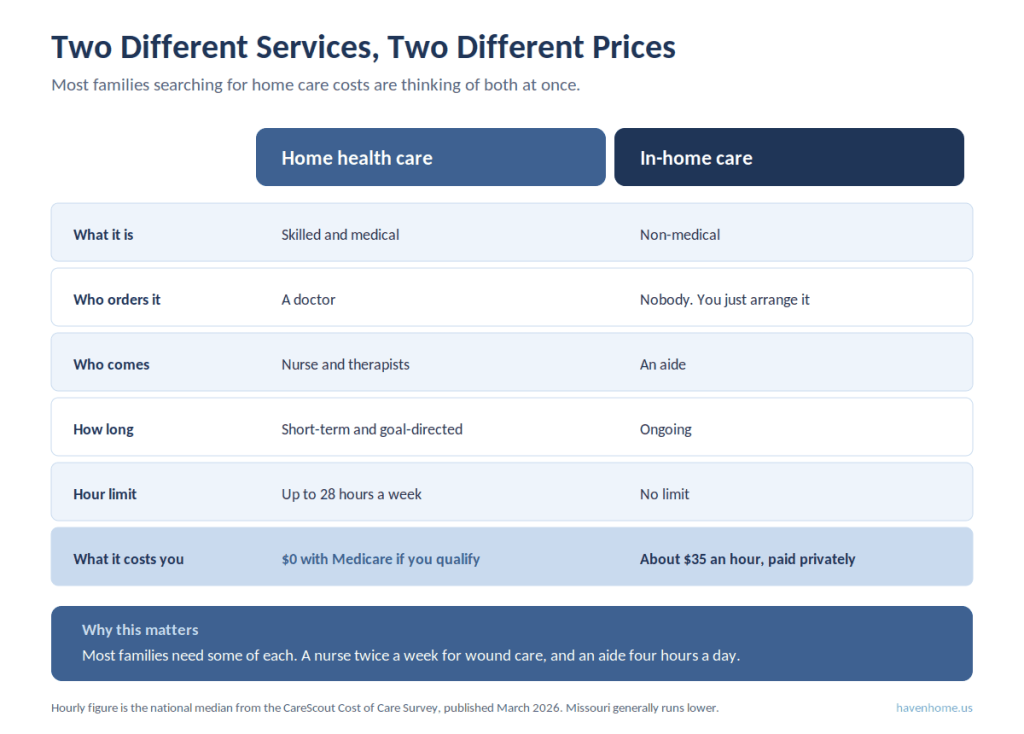
In-home care is the hourly help with bathing, dressing, meals and company. Medicare does not pay for it when that is the only care needed, so most families pay privately. Nationally the median is about $35 an hour.
That gap is the whole story. One service is free and limited. The other is unlimited and expensive. Almost every family ends up needing some of each.
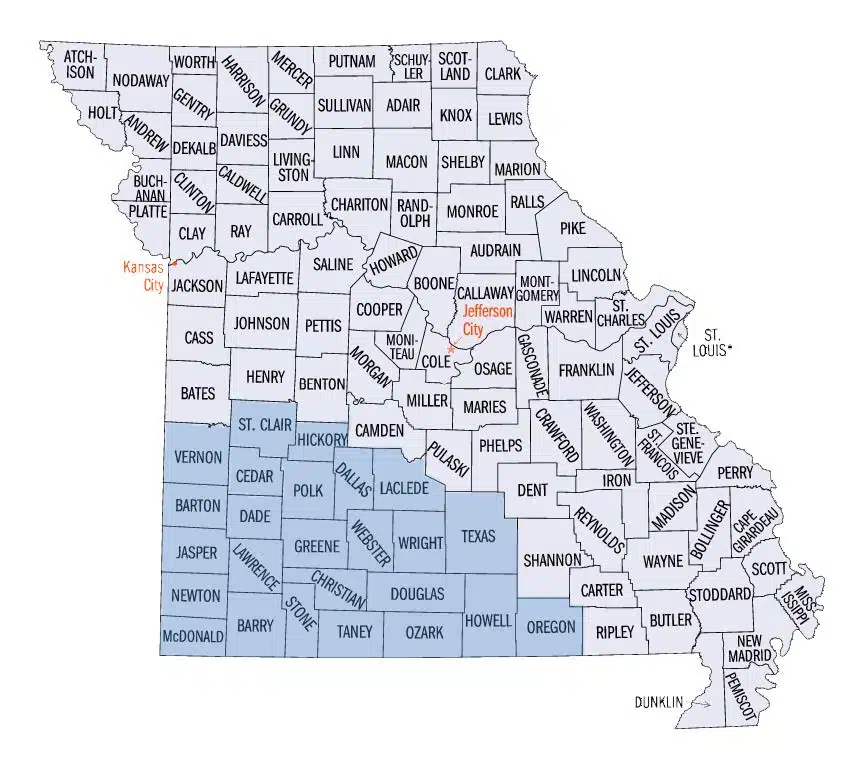
This guide covers what each one actually costs, what around-the-clock care runs to, and what to do if you cannot pay privately. If you want a straight answer for your own situation, you can call our team in Ozark and ask.

Two different services, two different prices
Worth getting clear before any numbers make sense.
Home health care is skilled, medical and ordered by a doctor. A nurse, a physical therapist, a speech therapist or an occupational therapist comes to the house. It is short-term and goal-directed, usually after a hospital stay, a fall or a new diagnosis. Medicare pays when your parent qualifies.
In-home care, sometimes called private duty or personal care, is non-medical. An aide helps with bathing, dressing, meals, laundry, errands and company. It is ongoing rather than short-term, and it is billed by the hour.
Families often need both at once. A nurse visiting twice a week for wound care, and an aide four hours a day so somebody can shower safely. Those come from two different budgets.
What does Medicare-covered home health cost?
Nothing, for the services themselves.
When your parent qualifies, Medicare covers the nurse visits, the therapy, the aide visits that accompany skilled care, medical social services and supplies, with no deductible and no coinsurance.
There is one exception. Durable medical equipment such as a walker, a wheelchair or a hospital bed carries 20% coinsurance after the Part B deductible.
The limit is not money, it is hours. Medicare covers care that is intermittent, which it defines as up to 8 hours a day combined, for a maximum of 28 hours a week, with up to 35 hours a week possible for a short period if a provider decides it is necessary. Within those limits, Medicare says that if you qualify, you can get unlimited home health visits.
So Medicare home health is free, and it stops well short of what a family needing daily help actually requires. We cover the eligibility rules in our guide to what homebound means.
What does in-home care cost per hour?
This is where the real money is.
The most recent CareScout Cost of Care Survey, published in March 2026 using 2025 data, put the national median for a non-medical caregiver at $35 an hour, up 3% year over year. At 44 hours a week across a year, that works out to $80,080.
Two things to know about that number.
CareScout now reports homemaker and home health aide services together as a single category, because the two prices had converged. The old advice to look for a cheaper homemaker rate no longer saves much.
And the national median is a starting point, not a quote. Rates are collected by metro area, and Missouri generally runs below the national figure.
For a Springfield-area number, check the Springfield entry directly at carescout.com rather than relying on a state average.
What Actually Moves your Bill
Hours per week
Four hours a day, five days a week is a very different number from 24-hour coverage.
Nights, weekends and holidays
These usually carry a higher rate.
Minimum shift length
Many agencies require two to four hours per visit, so a one-hour need costs more than an hour.
Agency or direct hire
Hiring privately is cheaper per hour, until the caregiver is sick and nobody comes. An agency charges more and covers that.
What does around-the-clock care cost?
This is the number that changes families’ plans.
At roughly $30 to $35 an hour, continuous coverage means paying someone in shifts across all 24 hours. That reaches somewhere in the region of $15,000 to $20,000 a month.
At that point the arithmetic usually points elsewhere. A nursing facility often costs less for the same intensity of care, which is the trade-off families weigh, and usually the moment they start weighing it seriously.
Most families never get to 24-hour paid care. They cover nights themselves, bring in help for the hardest parts of the day, and rotate siblings. That is not a failure of planning. It is what the numbers do to almost everyone.
What if you cannot pay privately?
Four routes worth knowing, and most families do not know about the first one.
Consumer Directed Services. If your parent has MO HealthNet, Missouri’s Medicaid program, and needs a nursing-facility level of care, they may be able to hire and direct their own personal care attendant.
That attendant can be an adult child, another relative, a friend or a neighbor. A spouse or legal guardian cannot be paid this way. There is no waiting list. For a family already providing the care unpaid, this changes the whole picture.
Veterans benefits. The VA offers several programs that help pay for care at home for enrolled veterans and some surviving spouses. Eligibility rules are their own subject, so start with the VA directly or a local veterans service officer.
Long-term care insurance. If your parent bought a policy years ago, read it. Many cover home care and families forget they have it.
Medicare Advantage. Some plans offer limited supplemental in-home support that original Medicare does not. Call the number on the card and ask specifically what in-home benefits the plan includes.
Working out what your family actually needs
Before pricing anything, write down what the week actually looks like. Which tasks are genuinely unsafe for your parent to do alone.
Which hours are hardest. What a family member can realistically keep doing for another six months without breaking.
Then price only the gap. Most families start by pricing full coverage, get frightened by the number, and do nothing. Pricing the actual gap gives you a figure you can act on.
Three things to take away. Medicare-covered home health costs nothing but stops at 28 hours a week. Hourly in-home care runs around $35 an hour nationally, with Missouri generally lower. If your parent has MO HealthNet, Consumer Directed Services may pay a family member to provide the care already being given for free.
Haven is locally owned, based in Ozark, and serving Springfield, Ozark, Nixa, Republic, Rogersville and Branson. Call to ask what your family would actually pay.
Take Action Now
Find out what your family would actually pay
Locally owned, with our office in Ozark. Call for a straight answer about hours, rates and what Medicare or MO HealthNet would cover.